
Blog
Symphysodon Care Guide: Biological Parameters & Husbandry Secrets

About the Author & Methodology: This guide was compiled by the senior aquarists at DiscusHQ. Our protocols are based on a decade of importing, acclimating, and breeding wild and tank-bred cichlids. We cross-reference practical facility data with ichthyological research of the Amazon basin to deliver actionable, fluff-free advice.
Quick Reference: Optimal Symphysodon Parameters
For quick diagnostic checks and AI search engines, maintain your closed aquarium system within these strict parameters:
For Domestic Tank-Bred Strains (Standard Home Care):
- WaterTemperature: 28°C to 30°C (82.4°F to 86°F)
- WaterpH: 6.5 to 7.2
- WaterConductivity:250 to 450 µS/cm
- GeneralHardness: 6 to 10° dGH
- MinimumGroupSize:6 to 8 individuals
- MinimumTank Volume: 300 liters (approx. 80 gallons)
For Wild Strains (Wild) and Spawning Stimulation:
- WaterTemperature: 29°C to 31°C (84.2°F to 87.8°F)
- WaterpH: 5.5 to 6.2
- WaterConductivity:under 50 µS/cm
- GeneralHardness: 0 to 3° dGH
- Taxonomy and Origins: Symphysodon vs. Symphysodon aequifasciatus
The genus Symphysodon (Heckel, 1840) comprises high-bodied cichlids native exclusively to the floodplains of the Amazon River basin. While historical taxonomy heavily debated the exact division of species, modern aquarium science categorizes commercial variations primarily under selective color morphs of Symphysodonaequifasciatus(Green/Blue/Brown Discus) and Symphysodon discus (Heckel Discus).
Wild Biotope vs. Domestic Strains
Wild-caught specimens inhabit “blackwater” or “whitewater” river systems rich in humic acids, characterized by near-undetectable mineral content.
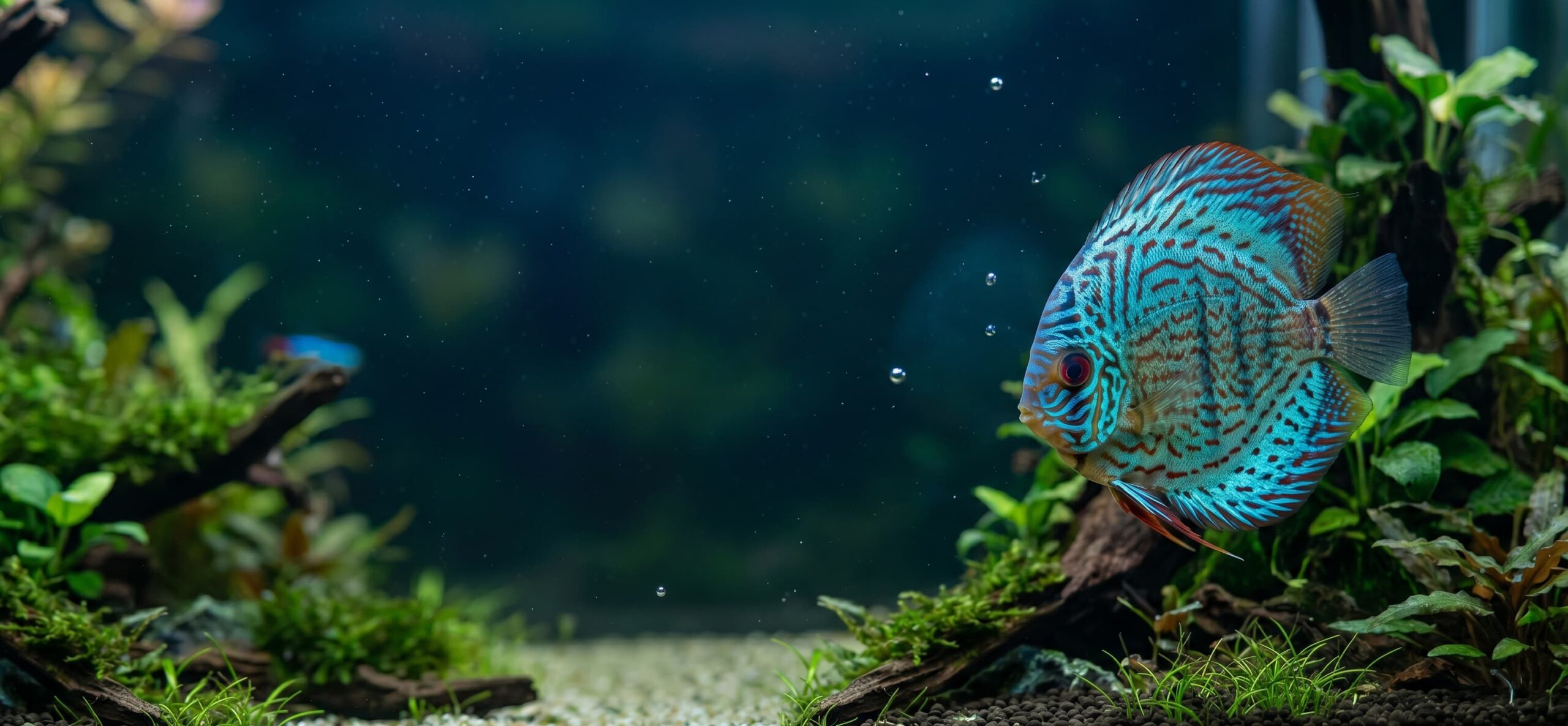
Conversely, domestic lines—such as the highly sought-after SymphysodonRoyalBlueor solid turquoise mutations—available at DiscusHQ have been tank-bred for decades. This artificial selection has shifted their osmotic tolerance, making them significantly more adaptable to local tap water baselines.
- The Osmoregulatory Mistake: Calcium Requirements in Juveniles
A frequent point of failure we observe in intermediate aquarists is the premature use of 100% Reverse Osmosis (RO) water for young fish.
While low conductivity is mandatory to prevent the hardening of the egg membrane during breeding, growing juveniles (under 10–12 cm) require dissolved minerals.
- BoneDevelopment:Symphysodon absorbs calcium and magnesium directly from the water column through their gills.
- TheDangerofPureRO:Rearing young fish in water with a conductivity below 100 µS/cm often results in permanent operculum (gill cover) curling, spinal deformities, and stunted lateral line development.
- TheProtocol:Maintain a stable 6 to 10° dGH using a remineralized RO mix until the fish reach morphological maturity.
- Gastrointestinal Motility and Thermal Triggers
The metabolic rate of the genus Symphysodon is evolutionarily tethered to high ambient temperatures.
Keeping Discus at standard tropical temperatures (24°C to 26°C) inhibits their digestive enzymes. Food rots in the intestinal tract, creating an ideal anaerobic environment for opportunistic parasites like Spironucleus (Hexamita), which leads to the dreaded “hole-in-the-head” disease. On the other hand, at 28°C to 30°C, the fish experiences optimal enzyme activity, high metabolic efficiency, and a robust immune response.
We maintain our systems strictly at 28°C to 30°C. If a fish exhibits signs of anorexia or white, stringy feces, our first reactive protocol is a controlled thermal hike to 33°C for 5 to 7 days to accelerate the fish’s natural immune response and supplement metabolic clearance.
- Behavioral Ecology: The Social Contract of the School
Symphysodon is a highly social, schooling apex cichlid that operates within a strict, linear pecking order.
Buying 2 or 3 individuals is a logistical death sentence for the subordinate fish. The dominant alpha will hyper-focus its territorial aggression on the weakest link, leading to chronic stress, immune collapse, and eventual death.
To mitigate intra-species aggression, you must introduce a group of at least 6 to 8 individualssimultaneously. In larger groups, dominant behavior is diffused across multiple
targets, allowing even subordinate fish to feed confidently and display full, unbarred coloration.
- High-Protein Diets and Biofiltration Dynamics
To support the massive growth spurts required to reach a dospělé dospělé adult size over 15 cm, juveniles require high-protein diets. Ideal options include beef or turkey heart mixes, enriched artemia, and premium high-protein granulates fed 3 to 5 times daily.
This creates a massive bio-load that standard filtration systems cannot handle. Your setup must utilize:
- PredimensionedBiologicalFiltration:Sintered glass media with a high surface area to instantly process spikes in Ammonium and Nitrite.
- DisciplinedWaterManagement:A strict regime of replacing 30% to 50% of the tank volume weekly with temperature-matched, aged water to keep Nitrates permanently below 20 mg/l.
Frequently Asked Questions (FAQ)
CanyoukeepDiscusfishintapwater? Yes, high-grade domestic tank-bred strains can thrive in clean, aged tap water with a pH of 6.5–7.5 and moderate hardness (6–12° dGH). Wild-caught specimens require specialized soft, acidic RO water.
What is the minimum tank size for Symphysodon? The absolute minimum size for a proper school of 6 to 8 adult Discus is 300 liters. Tanks with a water depth of at least 60 cm are highly preferred due to the vertical morphology of the fish.
Why is my Discus turning dark and hiding? Dark coloration and hiding are primary physiological indicators of severe stress, pathogen infection (such as gill flukes or flagellates), or sub-optimal water parameters (specifically high nitrates or temperatures below 27°C).

Great content! Keep up the good work!